

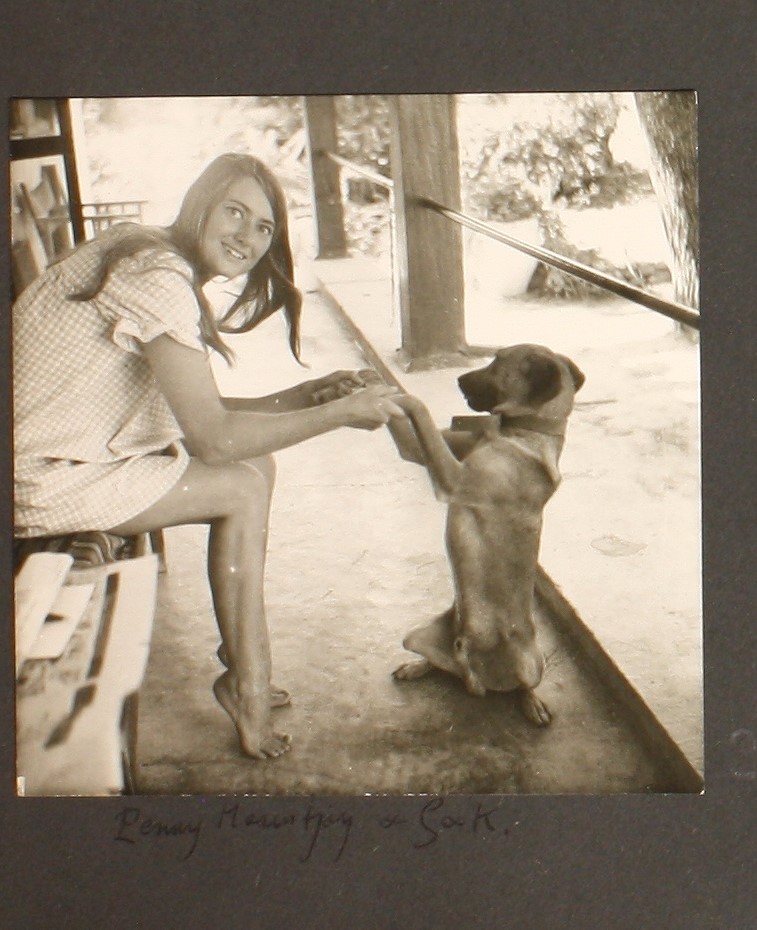
Dr Penelope Anne Mountjoy (1946 -2025)
The BSA community was saddened to hear that Dr Penelope Anne Mountjoy passed away on 14th June 2025, in Oxford aged 78. One of the leading authorities on Mycenaean ceramics, Penelope spent most of her life and career in close connection with the BSA, having been awarded Honorary BSA Membership in July 1996. Arriving at the School in summer 1970, as a Greek Government Scholar with her BA in Classics from the University of Bristol, she started researching what would become one of her landmark studies, Late Minoan IB (LMIB) Marine Style pottery, working intensely on this topic from 1970 to 1985. She continued this work during her MPhil at Bedford College, University of London. She later received her PhD for published works from the University of Bristol.
Penelope participated in numerous archaeological projects over this period, studying and drawing pottery at sites such as Myrtos Pyrgos and Knossos in Crete; Saranda Colonnes and Paphos in Cyprus; Phylakopi on Melos; and Mycenae. Understanding the value of the archaeological sciences from an early stage, she started incorporating scientific analysis in her research from 1975, first working with Richard Jones who was then head of the newly established the Fitch Laboratory at the BSA. It was during the study of the Citadel House (now Cult Centre) that she began her close association with Lisa French (co-director of study seasons at Mycenae with Lord William Taylour and later BSA Director), which she always acknowledged with affection and gratitude. While Penelope began her research career with work on LMIB pottery and published two early papers related to the Marine Style, it was this 1970 summer study season that seems to have aroused a consuming interest in Mycenaean decorated pottery, which was to be at the centre of almost all her subsequent research, in one form or another.
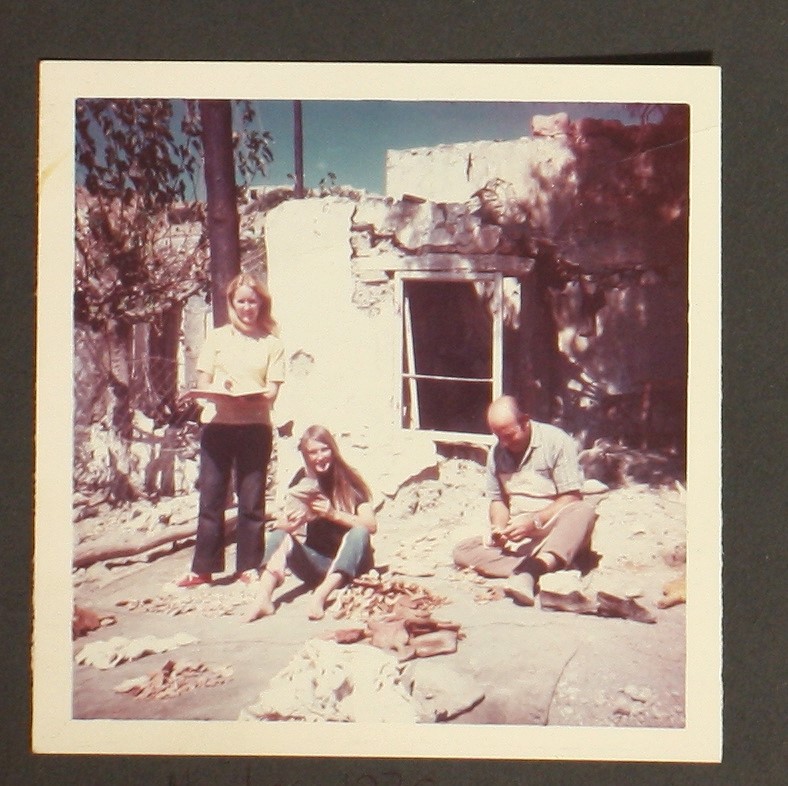
‘Myrtos 1970, Sara Paton, Penny Mountjoy and Petros’, Oliver Dickinson BSA Album, #97
Penelope also worked for the Swedish Institute at Asine, where she studied unpublished material from the pre-war excavations. This brought her into contact with the German Institute at Athens, which was working at nearby Tiryns, and would lead to her involvement with the site of Kalapodi. It was shortly thereafter that she was awarded an Alexander von Humboldt-Stiftung Fellowship from 1985 to1987 and again in 1990, spending much time in Mannheim and Heidelberg preparing her widely-used and highly impactful volume, Mycenaean Decorated Pottery (1986), and later her seminal work, Regional Mycenaean Decorated Pottery (1999), in the latter of which Penelope explored social exchange through the classification and stylistic development of decorated pottery. This enduring interest brought her to study in many Ephoreia ‘apothekes’ as well as museum storerooms across Europe.
In 1993 Penelope was invited by Manfred Korfmann of the University of Tübingen to join his team at Troy, which expanded her work on topics relating to links between the Aegean and Anatolian civilisations. She contributed considerably to the new work at Troy by defining the currently accepted dating for Troy VI and VII on the basis of Mycenaean links (and demonstrating that much of the Mycenaean pottery was locally made, not imported), and developing the concept of the East Aegean-West Anatolian Interface, in which a local koine in pottery could be perceived, independent of influence from the Argolid or Rhodes. Results of this yearlong undertaking were published in Troy VI Middle, VI Late and VII. The Mycenaean Pottery (Studia Troica Monographien 9, 2017). Additionally, her expert analysis of the LH IIIC pottery from the site of Bademgediği Tepe, close to Smyrna, identified a remarkably wide range of connections.
Her lively interest in programmes of scientific analysis to determine the origin of particular pottery wares, on which she published many collaborative papers with H. Mommsen and others, naturally led her into questions of trade between the Aegean and the Near East, as well as the complex and much-debated issue of (possible) population movements in the Near East in the last stages of the Bronze Age. Her constant concern with studying the original material, in which she paid particular attention to the stratified material from settlement sites, culminated in the massive two-volume Decorated Pottery in Cyprus and Philistia in the 12th Century BC (2018), which provided information and analysis of the material from a whole series of sites that has so often been used in hypotheses arguing for an Aegean origin for the “Philistines” and other “Sea Peoples”.
Although Penelope returned to her work in Greece with the publication of the South House in Knossos in 2003, her research was mostly connected to the Cyprus American Archaeological Research Institute (CAARI) in Nicosia, Cyprus and the Albright Institute for Archaeological Research in Jerusalem, Israel until 2018, when she turned again to the study of connectivity and the links between Crete and Cyprus in the final decades of the Bronze Age and she returned to working on BSA material, specifically in Knossos.
Penelope showed boundless energy in searching out and studying material, whether unpublished and from old excavations or new finds. She displayed great readiness to travel and make new contacts, with the aid of impressive linguistic skills, and considerable tenacity in pursuing her projects through a series of short-term or part-time appointments. Some of her positions included teaching at Queens University, Kingston, Canada as Scholar in Residence and at the Universities of Mannheim, Tübingen and Frankfurt (at the latter as Mercator Gast Professor). She also held Alexander von Humboldt Fellowships at the Universities of Mannheim, where she was hosted by Professor Wolfgang Schiering of the Institute of Classical Archaeology, and Heidelberg (1985-1987, 1990); the Glassman Holland Research Fellowship (2008-2009) and Seymour Gitin Distinguished Professor Fellowship (2014-15) from the Albright Institute of Archaeological Research in Jerusalem; and a Senior Fellowship at Koç University Research Centre for Anatolian Civilisations, Istanbul. Her work received further support from the Institute for Aegean Prehistory (for Bademgediği Tepe and other projects), the Shelby White and Leon Levy Program for Archaeological Publications (2010, for the work on Cyprus and in the Levant), as well as the Michael Ventris Award (1978-79, for research on the South Slope of the Acropolis), amongst many others. Additionally, Penelope was a Visiting Fellow at the School of Archaeology, University of Oxford and a member of the German Archaeological Institute, and was made a Fellow of the Society of Antiquaries in May 1988.
From 1984 to 2023 Penelope also taught archaeological illustration for the College Year at Athens academic programme, where she trained numerous students her craft and made a lasting impression upon many. Penelope was thrilled when her colleagues and friends, Peter Pavúk (Charles University, Prague) and Anna Lucia D’Agata (CNR, Rome) presented her with a Festschrift, The Lady of Pottery: In Acknowledgement of her Outstanding Scholarship (2023, SMEA N.S. 3; Edizioni Quasar). Beginning with a wonderful summary of her academic accomplishments, it also includes a six-page list of all her publications. Some 30 boxes of her work-archive are now with Peter Pavúk at the Charles University in Prague, with the aim of facilitating study and ensuring the long-term preservation of her research materials.
Penelope was generous in sending offprints of her work, sharing her knowledge, and being ready to discuss a wide variety of topics relating to the Late Bronze Age in the Aegean and East Mediterranean. Her legacy is a much wider and more soundly established basis for the study of Mycenaean and Mycenaean-related pottery and the many topics on which its evidence can shed light. From the early 2000s, she settled into a rhythm of spending three summer months in Oxford, where she made full use of the Sackler Library and enjoyed a social life with a handful of Oxford friends who enjoyed her good cooking. The rest of the year she was in Athens, travelling and enjoying the company of her friends throughout the Mediterranean. Penelope will be remembered by her friends and colleagues around the world as good lively company and always ready to provoke or join in laughter.
– Oliver Dickinson and Helen Hughes Brock with contributions from the British School at Athens
image above: ‘Penny Mountjoy and Zak’ at the Taverna in Knossos, 1972, Oliver Dickinson BSA Album, #90