

Professor Richard Tomlinson (1932-2026)
The British School community is saddened to learn of the passing of Richard Tomlinson at the age of 93. Richard was a staunch supporter of the BSA for seven decades: beginning as a student of the School, he became Visiting Fellow in 1974-75, then Editor of its Annual from 1978-91, subsequently taking on roles as Chairman of its Managing Committee from 1991-95, and Acting Director from 1995-97. From 2001 until his death, he was a BSA Vice President. His valuable contributions to the School were rich and varied, and he will be much missed.
Richard Allan Tomlinson was born in Leigh-on-Sea on 25.04.32, moving with his family during the war years to Birmingham, where he would spend much of his adult life. He was educated at St John’s College, Cambridge, where he received a scholarship to read for the Classical Tripos. In 1957 he was appointed as an assistant in the Department of Greek at the University of Edinburgh, before returning south the following year to take up a position as Assistant Lecturer at the University of Birmingham. It was also in 1957 that he married Heather Margaret Murphy, with whom he shared the next 52 years and four children. Heather was one of Richard’s greatest supporters, accompanying him on his archaeological ventures when he directed fieldwork at Perachora and playing gracious hostess in the Upper House during Richard’s time as BSA Acting Director. They were separated only by Heather’s death in 2009.
As Richard’s academic career developed and flourished, his achievements were recognised in 1970 by his election as a Fellow of the Society of Antiquaries, and by his elevation in 1971 to the position of Professor of Ancient History and Archaeology at the University of Birmingham, a position that he held until his retirement from the University in 1995. It was at Birmingham University as an undergraduate student that my own path first crossed with Richard’s. He was a gifted and inspiring teacher, delivering well-crafted and riveting lectures on ancient Greek history as he paced the lecture room floor. He also enthralled us with his passion for ancient architecture, and with his acute commentaries on Greek vase painting, in the tutorials he held in his office with its pull-down screen and drawers full of Kodak slides that he would without warning pounce upon to illustrate a particular point that he wanted to emphasise.
-
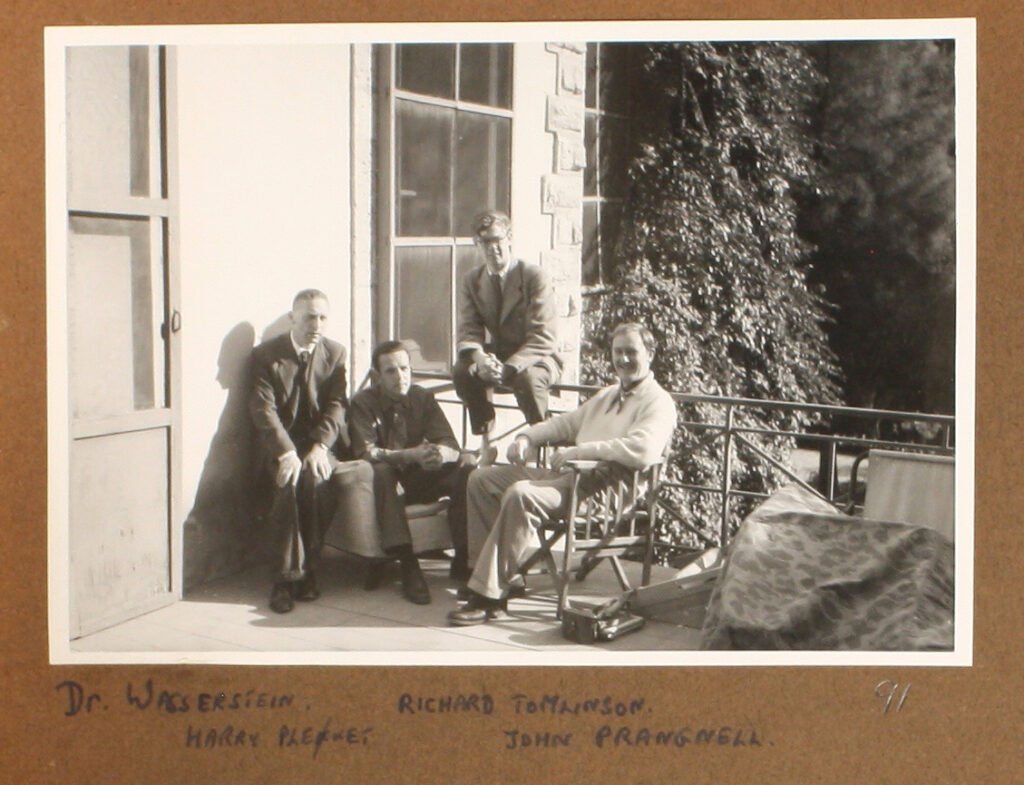
- Group on Finlay balcony, December 1955, from left to right: Dr Wasserstein, Harry Pleket, Richard Tomlinson and John Prangnell. BSAA/6/91 ©British School at Athens
Richard’s published academic output extended over a period in excess of 50 years, from 1961 until only a few years before his death. He authored seven monographs, excavation reports, a long list of journal articles and book chapters, and was an avid writer of scholarly book reviews. Throughout his academic career, his first love was ancient Greek architecture, a field to which he made major and lasting contributions to our understanding of the form, function and use of built space in sanctuary and urban contexts across the Archaic, Classical and Hellenistic periods. His interests and expertise also extended beyond the architectural to diachronic site and regional studies, focusing especially on Argos, Epidauros and Macedonia.
Between 1964-66 (under the direction of then BSA Director Peter Megaw), and again in 1972, Richard undertook excavation work at his beloved Perachora, focusing on the rich remains outside the Heraion, including the ancient hydraulic installations, and the Hestiatorion. In 1982 he returned to Perachora as field project director with a student team that included Ian Morris and myself, among others, focusing his attention on the large circular structure on the headland above the Heraion. We camped under canvas on the headland, and with no fresh water supply available locally, we had by necessity to make regular trips to Loutraki in Richard’s Landrover to fill up large plastic containers with water that we would then drive back to Perachora. Richard was an old school archaeologist, for whom such hardships were of no consequence, and he carefully regulated how much morning washing water each team member was allowed so that we didn’t run out before the next scheduled visit to Loutraki! Some 25 years later, in 1997, I had the pleasure of inviting Richard to Kato Phana on Chios, where he applied his invaluable architectural knowledge to analysing the foundations and spolia of the Temple of Apollo Phanaios.
-
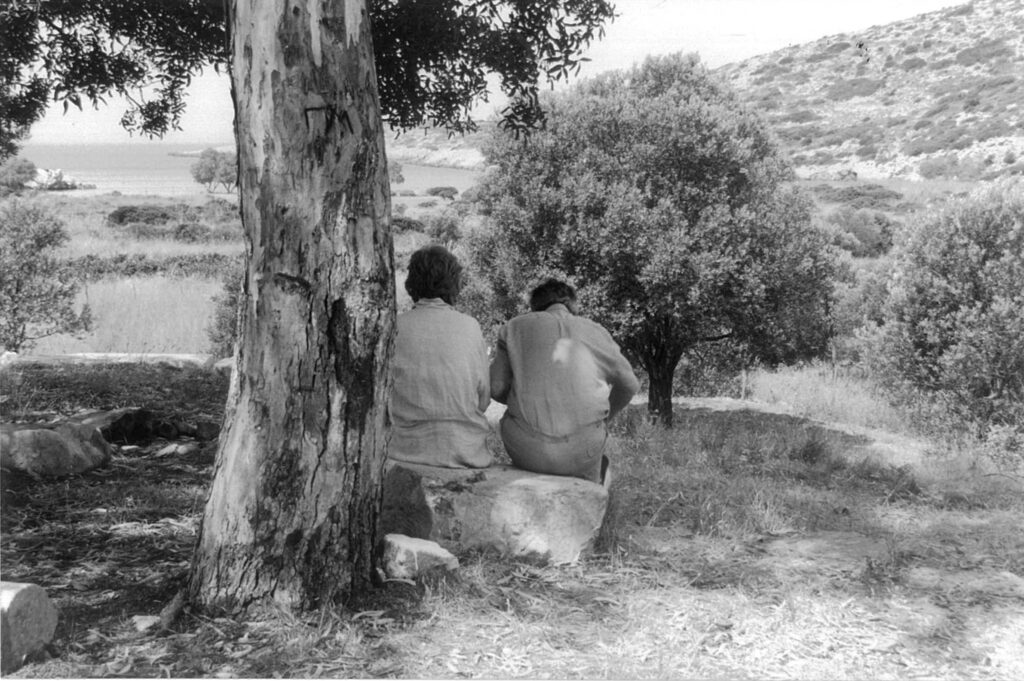
- Richard and Heather Tomlinson seated on an ancient ashlar block, looking out over the bay at Kato Phana in 1997 (image courtesy of Lesley Beaumont)
I, like so many other students and colleagues, benefited greatly across many years from Richard’s scholarly generosity and expertise, and in 2019 a festschrift, edited by Elena Partida and Barbara Schmidt-Dounas, was published in his honour, acknowledging and celebrating his contributions to Classical Archaeology. Its title, Listening to the Stones. Essays on Architecture and Function in Ancient Greek Sanctuaries, reminds us of the wisdom of Richard’s approach to the archaeological record – patient and meticulous observation of the ancient remains that allows us to hear what they have to tell us.
– Lesley Beaumont