

Call for papers – Women Archaeologists and War
4th workshop on Women in the Archaeology of Greece
Call for papers – Women Archaeologists and War
When: 09 & 10 March 2026
Where: EFA conference room | Didotou 6, Athens &
British School at Athens | Upper House
Organised by the École française d’Athènes and the British School at Athens, with the support of the British Embassy in Athens
Submission deadline: 31st December 2025
Contact & Information:
r.phillips@bsa.ac.uk & priscilla.ralli@gmail.com
Download the call for papers (EN)
The fourth workshop on Women in the Archaeology of Greece, jointly organised by the École française d’Athènes and the British School at Athens, will take place on 10 March 2026 following the launch of the proceedings from the 2023-2025 workshop on 9 March.
For its 2026 edition, the workshop focuses on the theme of Women Archaeologists and War. It examines the activities of women archaeologists in Greece in the period from 1910 to 1950, a time characterised by successive and related conflicts across Europe, from the Balkan Wars to World War One and World War Two. This period also includes the interwar years, the time after the end of World War Two, and the Greek Civil War. How did women archaeologists in Greece participate in these war efforts? Can archaeological archives help us to trace women’s roles in wartime?
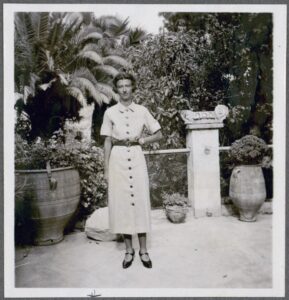
Women archaeologists took on various tasks in wartime: as nurses, ambulance drivers, code breakers, and aid distributors. They worked in Greek hospitals, with local war charities, and in intelligence offices based in Athens. One example is Mercy Money-Coutts, pictured here, who worked with the United Nations Relief and Rehabilitation Administration in Crete after World War Two. By looking at women’s wartime roles in detail, this workshop aims to explore the different ways that women contributed to war efforts in the early twentieth century, as well as the different aspects of social and cultural history that their actions illuminate. We are especially interested in the contested narratives around the topic of women in wartime, to understand the negative as well as the positive impact of their actions within the European political landscape. We also aim to highlight intersectional approaches that emphasise the interaction between social categories (such as gender, race, and class) and the broader structural conditions that influenced women’s work.
We welcome proposals about women who worked in Greek cultural institutions and universities as well as women who worked in foreign archaeological schools in Athens. We also want to emphasise the contribution of those women who came to Greece accompanying male relatives on archaeological work.
Questions of interest include, but are not limited to:
- How did women archaeologists contribute to war efforts in Greece?
- What was the relationship between foreign and Greek archaeologists at this time and how did national or institutional loyalties shape collaborations?
- How were women involved in the protection and preservation of archaeological monuments in Greece in times of conflict?
- To what extent did these conflicts afford women more freedom i.e. to work on excavations or in museums in Greece?
- How did political ideologies and propaganda influence their work and shape their legacies?
We invite proposals for biographic and thematic presentations (20 minutes, in English, Greek, or French) that shed light on any or all of these questions, with a focus on the roles and activities of women archaeologists in Greece during wartime. Abstracts (up to 300 words) can be sent to r.phillips@bsa.ac.uk and priscilla.ralli@gmail.com until 31st December 2025.
If you require accommodation or contributions to travel expenses, please contact the organisers.
It will also be possible to participate in the workshop remotely as it will be hybrid.
The proceedings of the workshop will be published (in English only) in a publication venue to be determined.