

The Keros Project
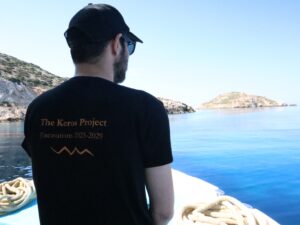
Approaching Dhaskalio by caique. Photograph by Catriona Gallagher.
Back in late May/early June, the BSA’s former Public Engagement and Development Officer, Catriona Gallagher, visited the Keros Project excavations. Catriona writes:
I joined the Keros team excavations at the end of May, five weeks into the project and one week before the end of the 2026 session. The Keros Project is one of the BSA’s biggest fieldwork endeavours in recent years, with this year’s 115 participants, its field school and 13 trenches across four areas of the uninhabited island of Keros and islet of Dhaskalio.
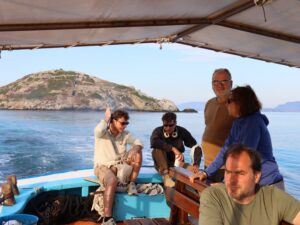
Michael Boyd and Evi Margaritis with members of the team. Photograph by Catriona Gallagher.
The Keros Project 2025-29 is formally a cooperative project between the Greek Ministry of Culture (Ephorate of Antiquities of Cyclades) and the British School at Athens, with the close collaboration of The Cyprus Institute. The project directors are Michael Boyd (BSA/CyI), Evi Margaritis (CyI) and Demetris Athanasoulis (EfAKyk).
The entire team stays on the neighbouring island of Ano Koufonisi where the apotheke (storage workspace and field laboratory) is also located, taking the boat across to Keros each morning and back each night, making the logistics and scale of this dig particularly impressive. Taking the boat at 7am with over 70 archaeologists, we sailed the short distance between the port of Ano Koufounisi and the island of Keros under exceptionally calm and still conditions – we heard that we got lucky there! The fieldwork team, led by project directors Evi and Michael, chatted quietly and sipped coffee as the caique cut through the still waters as dawn broke, slipping between the island of Kato Koufounisi and the islet of Glaronisi.
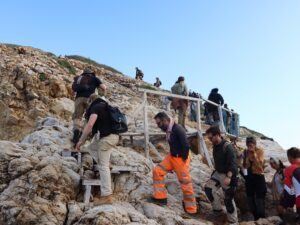
Disembarkation on Dhaskalio. Photograph by Catriona Gallagher.
The first stop was Dhaskalio at Keros’ western edge, a conical islet with steep rocky faces dropping to the turquoise shallow water, which in the Early Bronze Age was connected to the main island as a promontory. Just over half of the team disembarked here, zig-zagging their way up to the trenches which were clearly visible on our approach, running vertically from top to bottom of the islet. The caique then crossed the 90 or so meters to Keros’ opposite shore of Kavos where another 15 or so of the team hopped off the boat and clambered along the rocky paths up the slopes to the trenches.
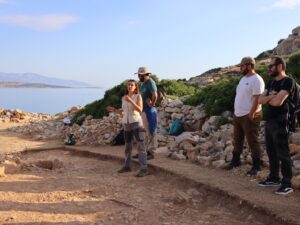
Ioanna Spanou, trench supervisor for Konakia, explains the discoveries. Photograph by Catriona Gallagher.
The boat then took us further along Keros’ north western shore, round the bay and dropping another 10 people at the rocks below the area of Gerani and where the drone team from University of Amsterdam set up their base station for the final day of Lidar flights. The remaining 15 of us in the visiting group, including Michael and Evi and the deputy mayor of Naxos and the Small Cyclades, Antonis Koveos, continued to the last boat stop and all disembarked at the abandoned village of Konakia, where the team are excavating the area next to an early Christian Basilica. At this site, Ioanna Spanou gave us a tour of the excavation area and debate ensued about the nature of the architecture and the burial found nearby.
Departing this area by foot, we then crossed back towards the area of Gerani where field director Cat Douglas gave us a tour of the Minoan building that was being excavated. This was found last year and this year its impressive and substantial architecture is really becoming clear.
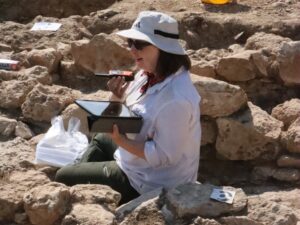
Digital data recording. Photograph by Catriona Gallagher.
It was exciting to see here how data gathered is immediately logged in the iDig app using iPads (a lot of this year’s equipment was kindly donated by Plaisio), from photos and measurements of soil and stone to records of everything found (commonly pottery sherds, obsidian or shell, for example, and occasionally more exciting finds like the odd Cycladic figurine head!).
Once more on the caique, we headed back to Kavos to be toured around the trenches at Kavos by field director Amira Kanwal where the team are investigating the links between ritual activities at Kavos and Dhaskalio. We also saw excavation taking place in the Special Deposit South, so-called because of the unusual finds of marble figurine and vessel fragments, and interpreted by Colin Renfrew as the site of a sanctuary.
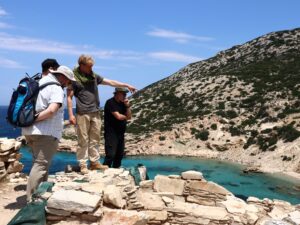
Jonah Walker, trench supervisor for Trench Q, points out architectural details at the summit. Photograph by Catriona Gallagher.
Finally, the next morning we returned to Dhaskalio itself, finally looking around the large trenches guided by field director Marie Floquet and trench supervisors Caroline Bruyère, Jeff Banks, Dom Rossi, Daniele Redemante, Jonah Walker and Phil Maier. Dhaskalio is remarkable for its dense and complex architecture, and with the excavation reaching the end of the second season in most areas the fallen stones from the buildings have been removed revealing the outlines of buildings, streets, terraces, drains and entranceways. The urban layout is truly impressive, and next year the team expects to be excavating floor levels everywhere, which will give valuable clues to the range of daily practices of the inhabitants (most outstanding of which was metalworking: Dhaskalio was the most important metalworking site in the Cyclades).
Returning to base camp, we were shown around the apotheke by manager Kyriaki Tsirtsi and pottery specialist Jill Hilditch, formerly of the Fitch Laboratory, seeing the vast amount of finds being brought back from Keros to be studied and catalogued in the project’s integrated database.
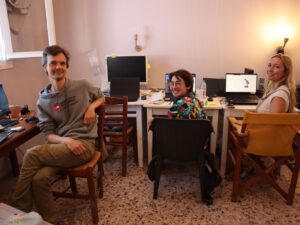
Hallvard Indgjerd (left) and Rosie Campbell (right), leading the digital team; centre, James Chanfrau. Photograph by Catriona Gallagher.
We then met the digital team led by Hallvard Indgjerd & Rosie Campbell, which has expanded to 8 people this year. Half of the team members work round the clock at base station and the other half are operating in the field each morning, having set up a local wifi network on Keros to connect all the gathered data from the project. Hallvard oversees a live, responsive database that helps facilitate communication between the apotheke studies and the field. Rosie meanwhile is responsible for the 3D recording and modelling of unit excavated on the site. The result of this entirely paperless excavation is far faster decision making and responsive analysis, a radical leap for this, probably the world’s first fully digital excavation.
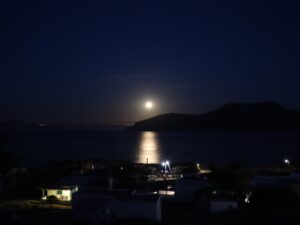
Full moon over Keros. Photograph by Catriona Gallagher.
It was joyous to see the team able to relax and let off steam dancing at the 30th May Fisherman’s Festival, and experience the incredible landscapes of Keros and Koufonisi under the May sun and the full moon. Although it was a brief visit to a very exciting excavation on an ambitious scale, it’s easy to see why people get the Keros bug. Stay tuned for further information on this year’s project findings, particularly during the BSA Annual Open Meetings in February 2027.
Read more about the project here: https://kerosproject.org/