
School Teacher Fellowship Experience 2026
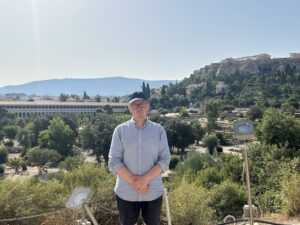
Ronald Vose at the Ancient Agora in Athens
The School Teacher Fellowship at the British School at Athens is offered each year to enable a teacher to pursue a project in Greece designed to enhance their teaching (for example by researching a course, preparing teaching materials, visiting sites or using the Library).
This year we had teacher Ronald Vose as one of our School Teacher Fellows and this is what he shared:
The central focus of my School Teacher Fellowship was to explore how we might develop and plan our Classics curriculum to look beyond elite voices and experiences, fostering a more inclusive and accessible understanding of the past. Much of the evidence through which students studying OCR Classical Civilisation encounter the ancient world comes from literary and political traditions produced by or concerned with relatively privileged groups. My aim was therefore to investigate how material culture might allow students to reconstruct something of the lives of the people who are less visible in those traditions: the people who worked, traded, worshipped, raised families, performed, travelled and participated in the everyday life of ancient Greek communities.
I wanted to produce resources that could support both curricular and supercurricular study.
I spent the week moving between archaeological sites and museums in Athens and the BSA Library, using the two in combination. At the Theatre of Dionysus, the Acropolis, the Ancient Agora, the Pnyx and the museums, I was able to encounter evidence of ancient life directly and consider what it might reveal about the people who created and used these spaces and objects. Particularly valuable were the less obviously monumental forms of evidence: votive offerings associated with individuals, objects connected with domestic life and childhood, weights and measures associated with trade, evidence of civic participation, funerary monuments and representations of theatrical performers. At the BSA Library, I followed up this first-hand experience with wider reading, particularly around Athenian religion, theatre, material culture and the physical development of the Theatre of Dionysus. Access to these academic resources also enabled me to develop a high-quality reading list to support students’ supercurricular study. Throughout the week, I became increasingly interested not simply in collecting interesting artefacts, but in how each object could become the starting point for enquiry-based learning: what can we observe, whose experience does it represent, what can we reasonably infer, and what can the evidence not tell us?
This has given me a clearer model for developing the curriculum. Rather than treating material culture as supplementary illustration for the literary and historical narratives students already encounter, I want students to use it as evidence in its own right. The resulting resources – including a lesson in our introductory unit which foregrounds how evidence is used to reconstruct the classical world – will introduce students to the ancient world through questions about ordinary lives and lived experience, while also helping them recognise the limitations and biases of the surviving evidence. This is particularly appropriate to the OCR course, which explicitly requires students to evaluate visual and material culture as evidence for the classical world, including its usefulness and limitations.
The fellowship has therefore been valuable not merely in expanding my own knowledge as a new Classics teacher, but in helping me rethink how I might best teach the subject. The photographs, observations, research and object enquiries developed in Athens will feed into the introductory study of Ancient Greece, enrichment and recruitment work, and the teaching of Greek Theatre. More broadly, the experience has given me a practical way to challenge the idea that Classics is principally the study of famous writers, politicians and monuments: by bringing the material traces of the much larger and more diverse communities who inhabited the ancient world into the classroom, we can ask students to think about whose experiences survive in the evidence, whose do not, and how we might reconstruct the past responsibly from what remains. In doing so, the project aims to make Classics both more representative of the ancient world and more accessible to students who may not already see themselves reflected in the traditional ways in which the subject is presented.
We thank Ronald for the valuable insights into his experience which highlight how he will be able to integrate his learnings into his future teaching, which is exactly what this fellowship is intended for.
Our School Teacher Fellowships will open again next year so keep an eye on our website and social media for any updates.