
Introduction to Ceramic Petrology Course 2026
From 19 to 29 May 2026, the Fitch Laboratory will hold a hands-on training course providing an introduction to ceramic petrology, building upon the Laboratory’s expertise in ceramic petrology applications and its extensive reference collections of geological and ceramic thin sections.
The course is designed for participants with no or limited prior experience in petrology, although familiarity with archaeological ceramics (or related materials) is essential. It is an excellent introduction for students undertaking a research degree in archaeological materials, as well as for postdoctoral researchers and academics who wish to become familiar with applications of ceramic petrology. Although the primary focus is on ceramic materials, the skills acquired are also applicable to the study of lithics, building materials, pigments, and soils.
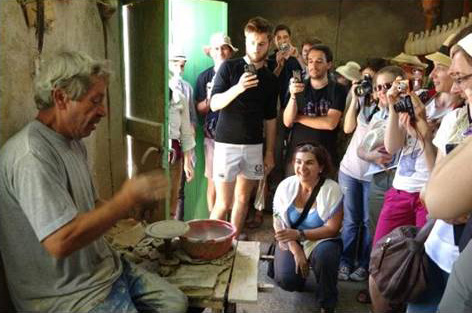
The course comprises daily lectures and practical sessions introducing optical polarizing light microscopy, the identification of major rock-forming minerals, rock-type classification, and the use of geological maps. These are followed by the analysis of thin sections of archaeological ceramics and processed raw materials to reconstruct provenance and technology. Participants are also introduced to the principles of other scientific techniques that can be combined with ceramic petrology (such as elemental analysis or X-ray diffraction), including a critical review of the most commonly used methods and demonstrations of how they are applied in different types of research projects on archaeological ceramics. A demonstration will be given on the preparation of thin sections and samples for chemical analysis. In addition, a field class to Aegina, including a visit to a traditional pottery workshop, provides practical experience in prospecting for pottery raw materials and sampling, as well as insight into contemporary pottery practices. Towards the end of the course, participants have the opportunity to undertake a case-study project.
In total, the course includes 37 hours of lectures and laboratory practicals, an additional 11 contact hours for project work, and a one-day field trip.
Course handouts and a field trip guide are provided to participants, covering all aspects of the course and including suggestions for further reading. A certificate of attendance is issued to each participant upon completion of the course. The course is organised as a collaboration between the Fitch Laboratory (British School at Athens) and the Keramos Research Group (Department of Geology, University of Patras). The instructors include Evangelia Kiriatzi, Sergios Menelaou, Carlotta Gardner, and Artemios Oikonomou (Fitch Laboratory), as well as Ioannis Iliopoulos (Keramos).
Course Fee: The course fee includes tuition; bed-and-breakfast accommodation for 12 days; field trip expenses; all teaching materials; British School at Athens (BSA) membership for one month, including 24-hour access to the library and free entry to archaeological sites and museums in Greece; as well as daily coffee and biscuits, a packed lunch for the field trip, welcome drinks, and a farewell meal. The fee is £1,200 (including accommodation).
Self-catering accommodation (including breakfast) will be provided at the BSA Hostel, adjacent to the Fitch Laboratory building (https://www.bsa.ac.uk/member-services/accommodation/). Travel to and from Athens and health insurance are the sole responsibility of the course participant. Post-graduate students are encouraged to apply to their universities for financial support. A limited number of bursaries will be available (to cover part or all of the fees) only for students who would otherwise be unable to attend; applicants wishing to be considered for such support should indicate this in their application.
Applications will include a brief cover letter outlining the candidate’s background and interest in participating in the course, a CV, and names and email addresses of two referees.
APPLICATIONS ARE NOW CLOSED
Closing date: Friday 6 February 2026. References must also be received by then through e-mail: it is the applicant’s responsibility to ensure that the references are sent.
The course is limited to 12 places. Selection will be based on the applicant’s academic profile, experience in ceramic studies, potential contribution of ceramic petrology to the applicant’s research and career plans as well as references/support letters. The successful candidates will be informed by late February 2026.
For further information, please check the relevant sections on the British School at Athens web pages (http://www.bsa.ac.uk/) or contact the Fitch Laboratory Director, Evangelia Kiriatzi (e.kiriatzi@bsa.ac.uk.), or the Fitch Laboratory Administrator, Zoe Zgouleta (zoe.zgouleta@bsa.ac.uk).