

Events Calendar – British School at Athens

- This event has passed.
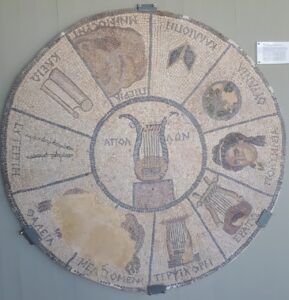
Disc with the symbols of the nine Muses and Mnemosyne, wikimedia commons
Philosophy Seminar
Professor Alex Long (University of St Andrews), “Platonic protreptic and the unity of the Phaedrus“
Abstract: Plato’s Phaedrus is widely regarded as the first expression in the Greek and Roman traditions of the view that literary compositions should possess ‘organic’ unity. And yet it is an apparently disjointed work, and the question of its own unity is a long-standing puzzle. The paper argues that there is a function shared by each part of the dialogue: illustrating and defending an indirect approach to protreptic (that is, the conversion of another person to philosophy), where the protreptic is left unannounced and exploits the other person’s pre-existing interests. The dialogue thus defends the distinctive approach to protreptic taken in Plato’s dialogues more generally.
Please note: Lecture handout notes are available here
Bio: Alex Long is Professor of Classics at the University of St Andrews. He works on early Greek philosophy, Plato, Hellenistic philosophy and Roman philosophy, and his publications include Death and Immortality in Ancient Philosophy (CUP 2019) and Conversation and Self-Sufficiency in Plato (OUP 2013). Together with Voula Tsouna he edits the book series Key Themes in Ancient Philosophy, and he and Thomas Johansen are the editors of the journal Phronesis.
Hybrid seminar
Location: Elli Lampridis Philosophical Library, Ipsilantou 9, 106 75 Athens
Registration is not required for in-person attendance
To attend online via webinar, please register here
This is a two part seminar series. The seminar at the Academy of Athens will be preceded by a seminar at the BSA on Tuesday 3rd March 2026, 17:00 (hybrid), titled ‘The city-cosmos contrast in Plato’s Timaeus and Critias’.
When: 4 March @ 5:00 pm - 6:00 pm EET
Where: Elli Lampridis Philosophical Library – Athens – Ipsilantou 9