

Events Calendar – British School at Athens

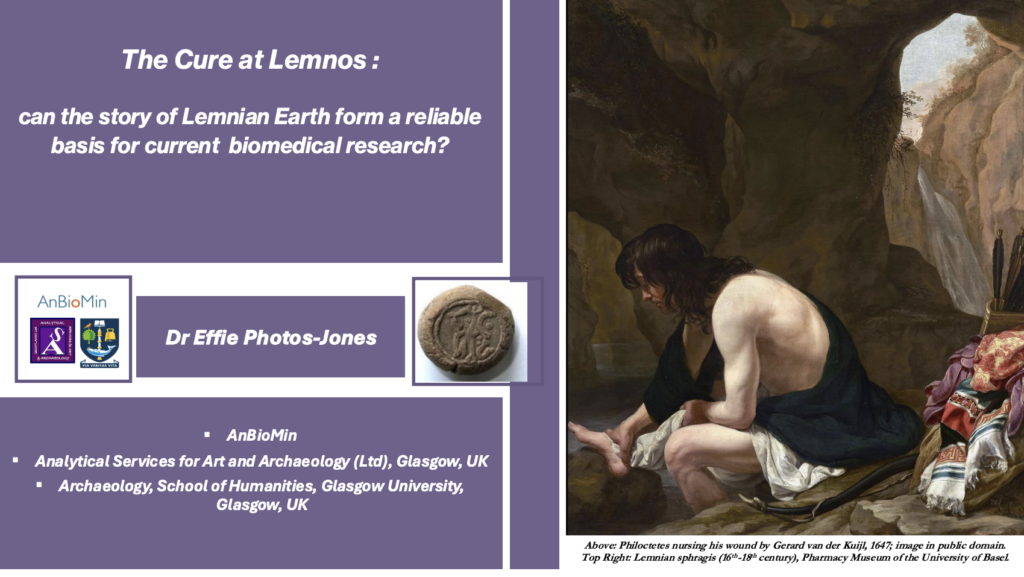
BSA Friends Greece lecture
Dr Effie Photos-Jones
(University of Glasgow [Honorary Researcher] and SASAA Ltd)
“The Cure at Lemnos: can the story of Lemnian Earth form a reliable basis for current biomedical research?”
Abstract: Lemnian Earth (LE) and its specially prepared pellet-shaped product, Lemnian Sphragis (LS) (terra sigilata) was a medicinal clay with an acclaimed history of use over 2500 years. It served as an antidote to ‘poison ingested or injected’ but also a powerful medicine against hemoptysis/ hematemesis. In the Ottoman period it was used against the ‘plague’. It was traditionally extracted from a locality in N Lemnos, under the auspices of the local temple and later, the Greek Orthodox clergy. Over a 20+ year period our team, in the UK and Greece, has carried out multidisciplinary work on LE/LS. A scrutiny of the ritual of its ‘blessing’ (Galen (2nd c CE)), suggests the possible introduction of a biotic component (fungal-infested wheat/barley) ‘absorbed’ by the clay.
This working hypothesis led to co-culturing of Lemnos-type clays with the fungus Penicillium purpurogenum and subsequent laboratory testing against common pathogens, with differing results. Feeding the ‘successful’ co-cultures to healthy mice resulted in an increase in gut biodiversity and SCFA (short chain fatty acids) production; the latter’s main attribute is to support the immune system and reduce inflammation. The research is ongoing, but far from being a ‘mythical’ cure, LS potentially finds itself at the cutting edge of modern biomedical research.
Bio: Effie Photos-Jones is Honorary Researcher in Archaeology, University of Glasgow. She is an archaeological scientist having undertaken her PhD on early iron metallurgy in Eastern Macedonia. She worked at NRC Demokritos and was chair of the Hellenic Society for Archaeometry in 2011-2014. In Scotland she set up in 1996 and since then directs the private company Scottish Analytical Services for Art & Archaeology, undertaking analysis of archaeological materials from numerous excavations. She also initiated a long-term research project funded by Historic Environment Scotland, on the early iron bloomeries of the Scottish Highlands. She is a member of the Society of Antiquaries of Scotland.
Her research work in Greece has focused on the industrial minerals of antiquity; the medicinal clays and alum of antiquity (Effie Photos-Jones and Alan J Hall Lemnian earth and the earths of the Aegean (Potingair Press 2011)). She led a British Academy funded project on Melos on the exploitation of industrial minerals in the Roman period (Effie Photos-Jones and Alan J Hall Eros Mercator and the Cultural Landscape of Melos (Potingair Press 2014)). This project subsequently extended to other sources of alum in the Mediterranean: the Bay of Naples and the Aeolian islands. Having established a geo-archaeological framework for the earths of the Aegean, in 2016, and with Wellcome Trust funding, she set up a multidisciplinary project, to investigate the nature of their purported pharmacological properties, undertaking both in vitro (lab-based) and in vivo (mouse-based) experiments.
Today’s talk is about the Lemnian Earth, the most well-known of them all, asking whether its long history can form a reliable basis for biomedical research today.
Hybrid
To attend in person in Athens, register here
To attend online via webinar, register here
When: 18 November @ 6:00 pm - 7:00 pm EET
Where: British School at Athens, Upper House – Athens – 52 Souedias Street