

Events Calendar – British School at Athens

Upper House Seminar
James Hua (BSA Macmillan-Rodewald Student/ University of Oxford), “Population Expulsions and Refugee Crises in the Archaic-Hellenistic Greek world: ubiquity, strategies, and exiles’ agency”
Abstract: Population expulsions and the refugee crises which followed were a remarkably frequent phenomenon in the ancient Greek world. This talk outlines the phenomenon and argues for the deep impact of mass refugees on the politics, history, and society of the Greek-speaking Mediterranean between c.650-315 BCE. Problematic though the ancient literary-historical sources on this topic are, they are supplemented by a wide range of more ‘emic’ evidence produced by the refugees themselves, which give us fascinating insights into their self-identities, experiences, and networks during and after exile. After detailing the synoptic view of all cases of mass exile and their various forms across regions, the talk will turn to the evidence produced by or involving uprooted populations and reconstruct their identities and political networks. While many exiles are lost to these community-destroying events, others survive and forge a complex set of ties and networks with other communities, including through a new type of discourse. Using epigraphic and numismatic evidence especially from Boiotia, Attica, and Makedonia, this talk traces the significant financial benefits and political networks which these exiles gained, and reappraises the resistance and agency they exhibited in a world defined by exile – and one which would loom larger in the Hellenistic world.
Bio: James is the current Macmillan-Rodewald Postdoctoral Student at the BSA. He completed his BA in Classics in Durham, and MPhil and DPhil in Ancient Greek History at Oxford. His thesis focused on population expulsions and refugee crises in the Archaic-Classical Greek world, and his project at the BSA extends his focus diachronically into the Hellenistic world, investigating the developments, continuities, and a broader outlook on contemporary mobility. James also works extensively with Greek epigraphy, acting as an Assistant Editor for SEG, with numismatics through various papers and the Oxford University Numismatics Society, and participates in various archaeological projects in Greece. He is also working on turning his thesis into a monograph, on part of which he will be presenting tonight. Finally, James also strongly believes in the importance of drawing on more recent diachronic refugee crises into his study, especially between Greece and Turkiye in 1922 onwards and more contemporary ones, and he thinks frequently with modern parallels and refugee studies.
Hybrid lecture
Please note: this event will not be recorded
To attend in person in Athens, please register here
To attend online via webinar, please register here
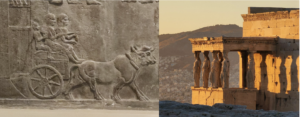
images: Expulsion of a civilian population (women, children, elderly) in Babylonia by Tiglath-pileser III (728 BCE, Nimrud). / Caryatids, Erectheion, Athens (421-406 BCE).
When: 20 April @ 6:00 pm - 7:00 pm EEST
Where: British School at Athens, Upper House – Athens – 52 Souedias Street