

Events Calendar – British School at Athens

- This event has passed.
Friends Online Lecture
Dr Matthew P. Evans (University College Dublin), “Carving Connections: Inscriptions and the Study of Migration, Mobility, and Networks in the Ancient Greek World”
Abstract: Scholarship on mobility and networks in the ancient world has often emphasised long-distance connectivity, especially in the Hellenistic period, when the networks of city-states expanded across and beyond the Greek-speaking world. Yet this perspective can obscure the regional and local movements that structured everyday interaction between neighbouring communities. This paper assesses what epigraphy can contribute to the study of such movement.
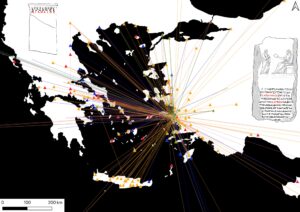
Focusing on inscriptions from Samos, Miletus, and Priene, the paper considers both the possibilities and limits of epigraphic evidence for reconstructing mobility and networks. Inscriptions record movement in diverse forms: diplomatic missions, proxeny and citizenship grants, religious travel, economic exchange, labour, transport, and the movement of resources. They also reveal the institutional and logistical frameworks through which mobility was authorised, commemorated, facilitated, or constrained.
At the same time, epigraphy does not offer a neutral record of movement. It preserves selective, formalised, and often elite-mediated traces of mobility, shaped by civic priorities and commemorative habits. By analysing what inscriptions make visible – and what they leave obscure – this paper argues that epigraphy is essential for moving beyond macro-scale models of connectivity towards a more grounded understanding of ancient networks across local, regional, and long-distance scales.
Bio: Dr Matthew Evans is an Assistant Professor (Ad Astra Fellow) in the School of Classics, University College Dublin. His current collaborative research project examines mobility and migration in the Hellenistic and Roman Aegean, predominantly using Greek inscriptions and a variety of digital tools including machine learning to assess human and resource movement on multiple scales. He also has interests in ancient athletics, gymnasia, and landscape archaeology. His research has been published in renowned journals like Hesperia, and his edited volume on sensory approaches to Greek athletics will soon be published with Bloomsbury (exp. Sept 2026). Prior to arriving at UCD, Matthew was a Leverhulme Early Career Fellow at the University of Leicester, and he has held teaching and research positions at the University of Warwick and the British School at Athens, respectively. He is also an active archaeologist, participating in fieldwork in Samos, Chios, and Amphipolis.
Online only
Please note, this lecture will not be recorded
To attend online via webinar, please register here
image: Provisional map showing the various connections recorded in the epigraphic corpora of Miletus, Priene and Samos. ©M. P. Evans, 2026.
When: 26 May @ 5:00 pm - 6:00 pm BST
Where: Online only – –