
Events Calendar – British School at Athens

- This event has passed.
Panel discussion
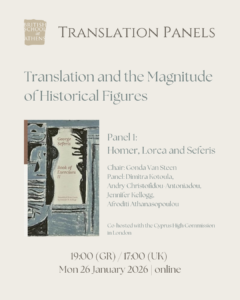
Panel 1: Translation and the Magnitude of Historical Figures: Homer, Lorca and Seferis
Co-hosted with the Cyprus High Commission in London
Chair: Gonda Van Steen
Panel: Dimitra Kotoula, Andry Christofidou-Antoniadou, Jennifer Kellogg, Afroditi Athanasopoulou
Dimitra Kotoula: ‘The Smile of Astyanax: Working with Homer’
My contribution to this workshop consists of posing questions, rather than providing answers. How does one break, as a creator, the barrier, the skin of a text’s language in order to rework it creatively? I will discuss my experience with Homer’s Iliad. The main section of my poetry collection, The Smile of Astyanax, revisits central episodes from the Iliad. For a case study, I will analyse my reception of one of these comparatively in Homer, Louise Glück’s The Triumph of Achilles (1985), and Nourri al Jarrah’s No War at Troy (2020). The open vulnerability of a text in translation will be tested. How does a poet work with authors who loom large in history and literature? There is no shortcut to poetry. And, as it seems, in their struggle with the giants, poets feel equally blessed and cursed.
Dimitra Kotoula is the author of four poetry collections. She is the recipient of the prestigious Chartis prize. Her poems have been translated into thirteen languages. Her collection of selected poems, The Slow Horizon that Breathes (translated by Maria Nazos with a preface by A. E. Stallings) was longlisted for the Runciman Award. She was the first to consistently translate Louise Glück’s poems into Greek, as well as those of Jorie Graham and Sharon Olds. She currently works in Athens as an art historian/ archaeologist.
Andry Christofidou-Antoniadou: ‘Challenges and Risks whilst Researching and Translating Federico Garcia Lorca’
The life and work of a literary figure is a real challenge for a researcher, which is even greater in the case of Federico Garcia Lorca, who has become a historic figure due to his assassination during the Spanish Civil War. A veil of mystery, myth, controversy, and silence surrounded his death for 39 years. Lorca’s works, although performed and read internationally, were banned in Spain until Franco’s death in 1975. The Franco regime tried to erase all traces of his existence. It was only in 2007 that the Spanish Congress of Deputies approved the Law of Historical Memory, which aims to ‘recognize the rights and establish measures in favour of those who suffered persecution or violence during the Civil War and the dictatorship’. Researching and translating Lorca has posed distinctive challenges. I will discuss how I worked on my book Federico Garcia Lorca in Three Dimensions under these difficult circumstances. I highlight the influences of Lorca’s life on his works and the importance of understanding the context of a writer before translating.
Andry Christofidou-Antoniadou studied French and Spanish at the University of London and Educational Psychology and Education at the Sorbonne. She also studied at the Universities of Zaragoza, Nice, Montpellier, and at the Pedagogical Academy in Erfurt. She retired from the position of Principal of Secondary Education in Cyprus. In addition to conducting research, she writes poetry, short stories, plays, novels, and essays. Her works have been translated into many languages. Her research on Lorca has been archived at the Lorca Centre of Studies and the Lorca Foundation in Spain. Her research on Cervantes has been archived at Cervantes Museums in Spain. She has collaborated with the Cyprus National Theatre, the National Theatre of Northern Greece and other theatre companies staging Lorca’s works. She has published 16 books and translated four literary books. She has been awarded many literary prizes. In 2019, she founded the Ad Litteram Cultural Development Centre in Limassol, which she is still directing. She serves as president of CIESART CHIPRE (International Chamber of Writers and Artists) and as Ambassador of Culture of the Deputy Ministry of Culture of Cyprus.
Jennifer Kellogg: ‘Translating Seferis in Character: Book of Exercises II in English’
Translating Book of Exercises II into English posed the double challenge of retranslating a voice we all know so well and integrating material that brought out unfamiliar sides of the poet. In this brief talk, I will share some of the challenges I faced in bringing together the poet’s sombreness, sarcasm, and satire.
Jennifer R. Kellogg holds a PhD in Modern Languages and Literatures from the ULB in Belgium and is a literary translator from Modern Greek. Her work has appeared in the Kenyon Review, AGNI, and Plume, as well as in other journals. Book of Exercises II is her first full-length translation from the Modern Greek and was published by World Poetry Books in 2024.
Afroditi Athanasopoulou: ‘The Politics of a Translation: Seferis and Warner’s Collaboration in Logbook III’
Abstract: I discuss the interplay between literature and politics by investigating Seferis’ interaction with the ‘friends of the other war’ in the context of post-war Anglo-Greek relations and the Cyprus question, which Seferis witnessed firsthand during his visits to the island (1953–1955) and diplomatic tenure in London (1957–1962). I focus on the so-called ‘Cypriot’ poetic collection of 1955, later renamed Logbook III, and the poet’s collaboration with his close friend Rex Warner in translating selected poems for inclusion in the 1960 edition, titled George Seferis, Poems (London). I emphasize the politics of this edition, which made Seferis’ work, notably the ‘Cypriot’ collection, accessible to the international community, culminating in his 1963 Nobel Prize in Literature.
Afroditi Athanasopoulou is Associate Professor of Modern Greek Studies at the University of Cyprus. Her research interests include Modern Greek Literature of the 19th and 20th centuries, especially Dionysios Solomos and Nikos Kazantzakis, as well as prosody and metrical analysis, the teaching of literature and the relations between literature and history. She also is interested in narratology and literary topoi. She has published the monograph History and Literature in Dialogue (Epikentro, 2016), and numerous articles in journals and collective volumes on authors and topics of Modern Greek Literature. She has also gained extensive experience in editing volumes, serving as a translator (from Italian) and/or proofreader of scholarly editions with significant impact in the field of Modern Greek Studies, published by prominent Greek publishers on the work of Kornaros, Solomos, Kalvos, Sikelianos, Cavafy, and others.
Online panel discussion
17:00 UK / 19:00 Greece (1.15’)
To attend online via Zoom webinar, register here
When: 26 January @ 7:00 pm - 8:00 pm EET
Where: Online only – –