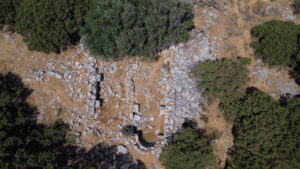
Excavation in 2024
One of the most obvious questions to ask about Kato Choria is its relationship with Kastro Apalirou, but also, because so little excavation has taken place of Byzantine settlements in this period more widely, the project aims to provide important new evidence for understanding Byzantine settlement, housing and lifeways in the Cyclades between the 7th and 11th centuries CE. In 2024 we followed up on the initial field survey with excavation in Areas D and F.
Area D
Two trenches were excavated in Area D based on surface remains already mapped in 2022. Trench D.1 contained three walls, two bonded together, giving insight into the development of the terracing system. Finds of Early Byzantine date (8th century CE) included amphora fragments and a quern. One certain and one possible cist burials were detected but not excavated. In Trench D.2, 16m to the north of D.1, excavation of three surface features revealed a possible platform or enclosure within which was set a cist tomb. The cist was partially excavated revealing one articulated burial and a second displaced burial. The grave featured a tombstone with an incised cross.
The graves in Area D reveal that at least two of the structures in this series of rooms were used for cist burial covered in stone slabs. The ceramic material suggests a date of the 8th century CE and was found with other domestic-type pottery, but no clear domestic horizons or floor deposits were encountered. The relationship of the burial in Trench D.2 with surrounding walls suggests it may have been inserted into earlier structures, though at this stage we cannot rule out the possibility that they were monuments to frame the cist burials. A small programme of scientific dating will help to resolve this question and add to the narrative of this part of the site.
Area F
In Area F, we excavated a significant part of a substantial building constructed on sloping, terraced ground, with excellent views to the northwest, west and southwest. Most of Area F was covered in very large stones from the collapsed building and material from the slope of the hill. The principal building measures at least 4.6 m x 4.9 m but is likely to be larger than this. Walls are about 0.75 m wide. Ceramics, mainly storage vessels, date to the 8th to 11th centuries CE, with some beehive fragments perhaps indicative of subsequent periods. Some of these ceramics and a piece of iron slag were found in a stone box-like construction 0.8 m x 0.6 m. Potential wall plaster fragments were also found in this room. Areas of organised collapsed stones originated from the collapse of the walls.
Results
In Area D, ceramics from the range of structures would seem to date to the 8th century CE. Further stratigraphic analysis of these structures and scientific dating of the skeletal remains will help reveal whether the structures were built as tombs or constructed at an earlier date as dwellings of some sort. We suspect that scientific dating of the burials may provide a relatively late date compared to the ceramics from the buildings, which may suggest that these burials were inserted into earlier buildings and add considerably to the narrative of these structures over several hundred years.
In Area F, a substantial stone building constructed in a location with impressive views of the surrounding landscape seems to have collapsed leaving a semi-articulated arrangement of stones lying in situ where they fell. No floor surface was reached on the interior of the lower (western) part of this structure but on the eastern side of Area F, an area of possible floor surface may extend further to the east (upslope). The stone box-like feature was associated with sherds and slag which might suggest a relatively late date compared to sherds found in Area D. Scientific sampling of the soil samples taken from the surface may provide an indication of the activities that were taking place there.
The excavations at Kato Choria provide the first excavated evidence of the non-monumental archaeology of the extra-mural settlement below Kastro Apalirou. Investigations of buildings from Areas D and F in 2024 have revealed evidence for material culture related to domestic activities as well as the use of buildings for burial. Initial observations would suggest that the chronology of the material encountered follows a similar timespan to the kastro with ceramics of the 8th and 9th century being particularly visible as well as some material which may date to the 10th or 11th century.