Years of operation: 2025-29
PIs: Rebecca Sweetman (British School at Athens), Dan Stewart (Leicester)
Background | Geophysical survey in 2025 | Excavation in 2026-29 | Links | Back to BSA research


Years of operation: 2025-29
PIs: Rebecca Sweetman (British School at Athens), Dan Stewart (Leicester)
Background | Geophysical survey in 2025 | Excavation in 2026-29 | Links | Back to BSA research
Knossos has a long history of excavation and publication. Even though the prehistoric remains have received much attention, the later periods have also been the focus of sustained scholarly research since the 1930s, beginning with the excavations of the Villa Dionysus and the subsequent investigation of the area to its south (the so-called ‘Roman Field’) alongside rescue excavations throughout the valley and the Roman remains above the Unexplored Mansion. In the 1990s several trenches in the Roman Field uncovered part of an impressive public building (perhaps a bath house). More recently, the Knossos Urban Landscape Project has delineated in unprecedented detail the extent and intensity of occupation of the valley in all periods, providing new insights into the extent and neighbourhoods of the Roman city.
The new project began with geophysical survey of the entire Roman Field in 2025, and will continue in 2026-29 with excavation of some of the many structures identified. The project brings together experts from across the UK and Greece to bring their area of specialization to collaborate on an innovative understanding of the city of Knossos. This project represents an original opportunity to get a full picture of city’s longue durée and its pivotal role in the history of Crete. In particular, the new project will chart the city’s underexplored renewal and development through the historic period. This diachronic project, incorporating geophysical survey, data modelling, excavation, environmental archaeology, analysis and legacy data, will be a model of integration. This multi-stranded approach is needed to achieve a step-change in understanding of the city’s growth and sustainability over the long term, including its ecological footprint and cultural landscape.
Much of Roman Knossos remains intact underground, undamaged by later developments, and is ripe for detailed investigation. A holistic approach to one area of the city that draws on legacy data to complement new environmental and archaeological studies will help support or refute theories of city space and layout, change over time and relationship between residents, with the ultimate aim of understanding daily life in a Roman provincial city.
Specific research questions include: how does the organisation of space in the north of the city compare to other cities in Crete and elsewhere in the Roman world? How do the city’s ecological and geomorphological affordances sustain urban life in the long term? What do the diachronic and integrated analyses of biocultural indicators (including elements that sustain life, information about the economy, and mortality data) tell us about the nature of life and human health through time? What of the nature of interaction can we delineate diachronically and at different scales, including within the urban area, within the immediate hinterland, between Knossos and other parts of the island, and at a larger scale within the wider eastern Mediterranean?
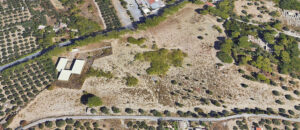
The so-called ‘Roman Field’ from the west (Villa Dionysus shelter to the north)
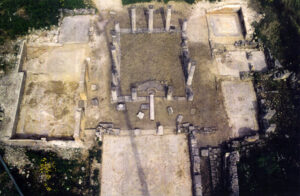
The Villa Dionysus with its mosaic floors
The first season of the Roman Knossos Project was carried out in the second half of May 2025, centred on geophysical survey. The survey recorded significant rectilinear features related to buildings, demonstrating major and plentiful architectural remains in the top 1-1.5m of soil throughout the Roman Field. Rather than the use of a fixed grid layout, different alignments for streets and buildings seem to have been determined by topography.
This initial season of the Roman Knossos Project aimed to use electrical resistivity to improve upon the results of a previous geophysical survey (2015-2019). The main aims were to provide increased detail of previously identified rectilinear features; to generate a spatial framework into which the current constellation of excavated but unstudied material from Roman Knossos can be placed; and to provide targets for further investigation in subsequent seasons, including both excavation and environmental sampling.
Previous work has shown that other geophysical techniques are challenging in the Knossos area – magnetometry tends to get ‘washed out’ by the specific local geology, and the lack of flat, obstacle-free terrain for Ground Penetrating Radar (GPR) makes large surveys impractical. The best conditions for resistivity are wet and open, and of the three techniques used at Knossos, resistivity provides the most clarity over the largest area. Survey units were recorded with a Hemisphere S631 GNSS GPS system, consisting of a base station plus rover. The base station was set up over a previously established control point on the roof of the BSA’s premises at Knossos.
While interpretation is not always straightforward, rectilinear features are evident, usually in the 1.0-1.5m depth range, and there may also be evidence of activity areas, housing, public buildings, roads, and some terracing. At least two orientations are visible in these results, one to the east parallel to the modern road, suggesting this may overlie one of the principal streets of the Roman city. Earlier work has suggested that much of the Roman city made use of the Minoan substructure in laying out the city, and this is potentially evident also within the urban core of the Roman Field, where several large terraces appear in the geophysics results. It will be interesting to test this hypothesis through excavation to learn the extent to which historic period inhabitants made use of, adapted to, and engaged with Minoan period material.
Standout features include a courtyard structure towards the east, with structural remains of rooms surrounding the courtyard. North of this is a large masonry structure (roughly 25m x more than 35m), perhaps similar to the so-called bath house discovered during the Knossos 2000 project. In the northwest sector a courtyard building, a street, and a terrace were detected near the Villa Dionysus.
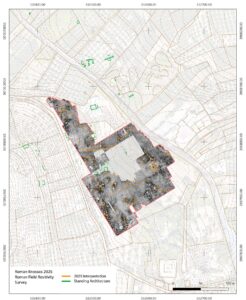
Results of geophysical survey in 2025
Knossos is a site with huge potential whose Roman (and Hellenistic) period is largely neglected. It has already proven an excellent site for trialling new technologies and methodologies, and it is clear that the aim of these new technologies must be to look both forwards and backwards.
The 2025 season of geophysical survey was intended to clarify results from previous work and provide targets for excavation in subsequent seasons. In 2026 we aim to focus initially on the northwest, which should provide interesting results that cross-cut categories of urban living in the ancient world, such as public infrastructure, domestic housing, and evidence of previous habitation and its impacts. Working in this area also provides us the opportunity to make use of previous work and fold some legacy data analysis into our own work.
Having identified streets, houses, utilitarian buildings, and a possible public building in the geophysical survey, we have a rare opportunity to flesh out this story through targeted excavations. A fundamental component of this project is to make this work and the legacy data from Knossos accessible to a wide public audience.
The excavation will produce high-resolution digital and 3D data and analytical samples for a wide range of techniques, including (for the economy of the site) environmental analysis (including archaeobotany, charcoal analysis, phytolith analysis, starch and lipid analysis, animal bone, fish bone and shell analyses), and for the range of activities taking place micromorphology combined with pXRF soil chemistry in buildings to investigate building history and in the wider area to understand broader scale changes through time. The micro-archaeological approach and full integration of scientific specialisms and associated sampling into the project from excavation to laboratory will herald a new era of fully interdisciplinary research taking advantage not only of the existing Knossos facilities and the world-class Fitch Laboratory, but also the School’s wide network of collaborations across Greece, Europe and beyond.
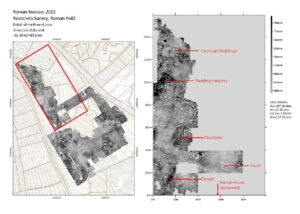
Results of geophysical survey in 2025. In the rectangle, the proposed main focus of excavations in 2026. On the right, detail of results in the northwest.