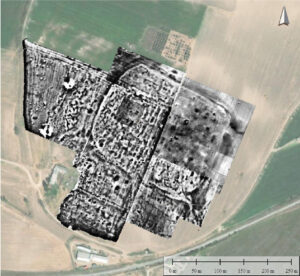
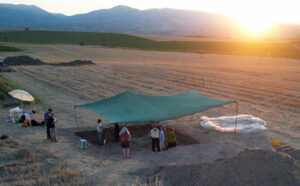
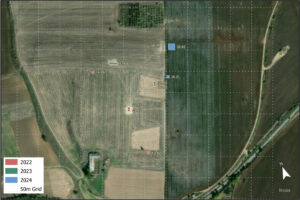
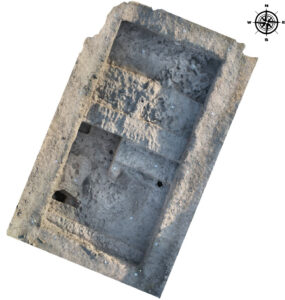
Conducted in 2022-24, the focus was on understanding the nature of the deposits, refining chronology, uncovering a representative Late Neolithic structure, and examining a large linear feature which from the magnetometry survey might form a wall, or a ditch and bank. Four trenches were opened in 2022 based on the magnetometry survey, with a further two in 2023 and two more in 2024. Trench G5.73 and G5.83 demonstrated two sub-phases within LN I, exposing an earlier building about 2.9m wide, with mudbrick walls and postholes for the superstructure, perhaps destroyed by fire. Part of a later building (still LN I) was also exposed in this trench.
Further north, Trench I6.21, excavated in 2024, revealed a potential kiln (oval, 1.6m x 1.0m, with a clay floor 0.7m x 0.7m), an associated waste deposit and an oval house (4.3m x 2.95m) made using mud in the pisé technique. The house was of the LN II period, and may have had an open area to the east.
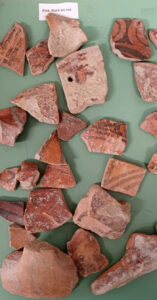
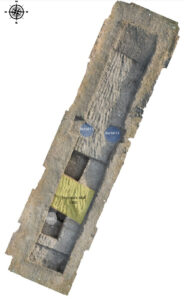
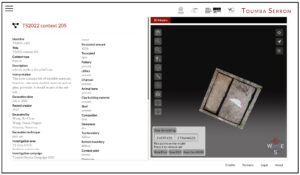
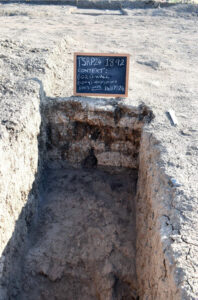
The linear feature was excavated in Trench H8.99, measuring 20m x 3m and set across the feature, which proved to be an earthen wall (mud or turf) about 3.5m wide. In a potential ditch associated with the wall two burials were excavated. As yet undated, these burials may prove significant as no Late Neolithic burials are known in the region. Further excavation nearby in 2024 in Trench I8.93 revealed more of the wall in association with LH I pottery. Excavation nearby uncovered a pit with LN I material (I8.92) and a potential dump area with mixed LN I and LN II pottery (I8.73).
The excavation has met its primary objectives and yielded significant findings. Notably, the unearthing of complete houses from both LN I and LN II periods, along with associated household structures such as a possible kiln and yard, provides new insights into the settlement’s structural phases. The LN II discovery is particularly remarkable, as in situ residential remains from this period had not been found in previous seasons, challenging the assumption that LN II residential strata on the hill had been largely destroyed. Furthermore, the continuation of the enclosure wall to the east was confirmed, validating the geophysical survey results. These findings suggest that the enclosure wall was actively used throughout the Late Neolithic I (LN I) period and possibly abandoned during the transition to LN II. The presence of a dump and previous discoveries of graves in previous seasons outside the enclosure in the northern region of the site support this theory.
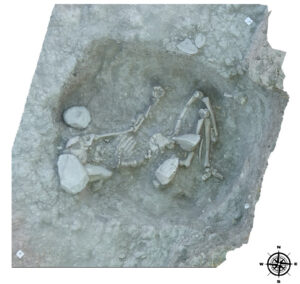
Feature 2 (eastern burial) in Trench H8.99